What goes on this handyman estimate template
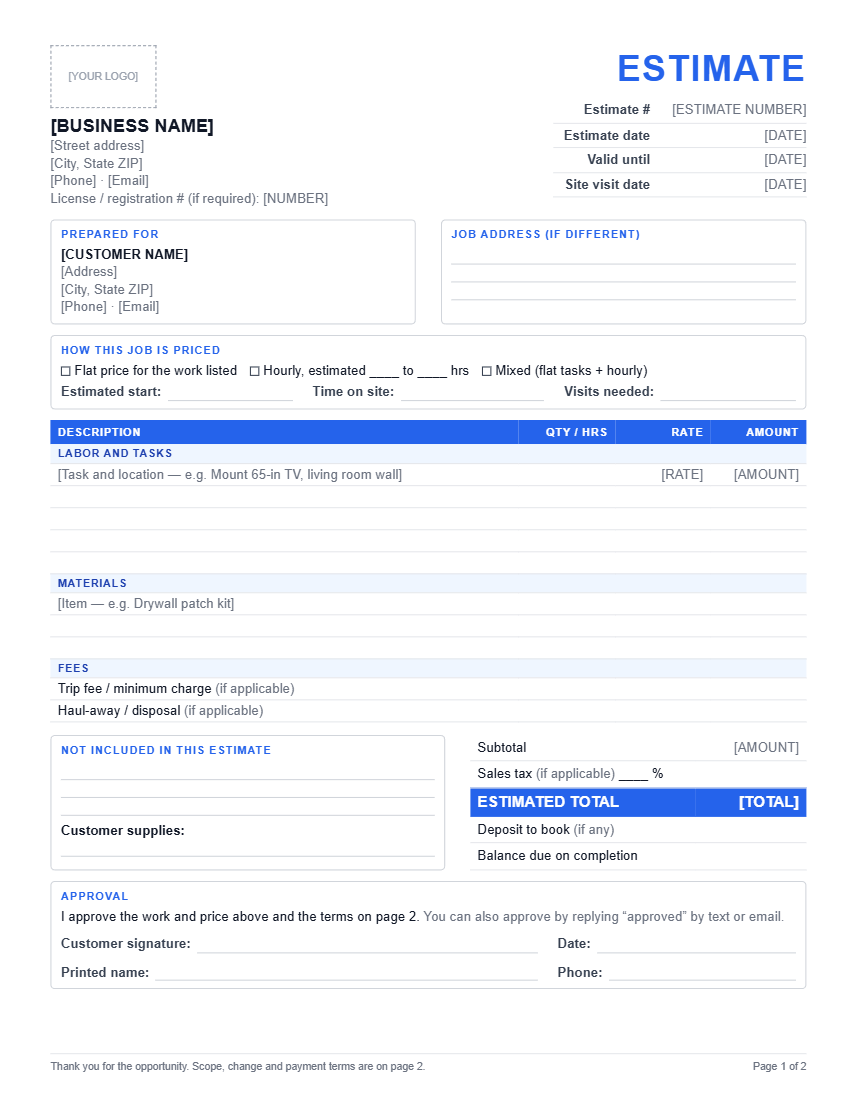
Each part of the template answers a question before the customer has to ask it.
- •Estimate number and dates. The estimate date, a valid-until date and the day you saw the job. When the customer calls back weeks later, you can find it fast.
- •Job address. Often not where the customer lives: a rental they own, or a parent’s house they’re arranging work for.
- •How it’s priced. Flat, hourly with a range of hours, or a mix. Tick one, so there’s no argument at the end about what the number meant.
- •One line per task, with the location. “Patch two doorknob holes, upstairs hall” is clearer than “drywall repair”.
- •Materials and fees. Kept apart from labor, so the customer can see what changes if they pick a different fixture.
- •Not included. The most useful box on the page: “Painting after drywall repair”, “Moving furniture”, “Electrical work beyond swapping the fixture”.
- •Approval. A signature, or a written “approved” by text or email.
Estimate vs quote
An estimate is your best price for the work as you understand it. If the job turns out different from what you could see, the price can change, within the terms you set. A quote is usually a fixed price for a defined job: if it takes you longer, that’s on you.
People use the two words loosely, so don’t rely on the title at the top. Tick the pricing box instead. “Flat price for the work listed” means the number holds unless the scope changes. “Hourly, estimated 3 to 5 hrs” tells the customer the likely range, and that the final bill follows the clock.
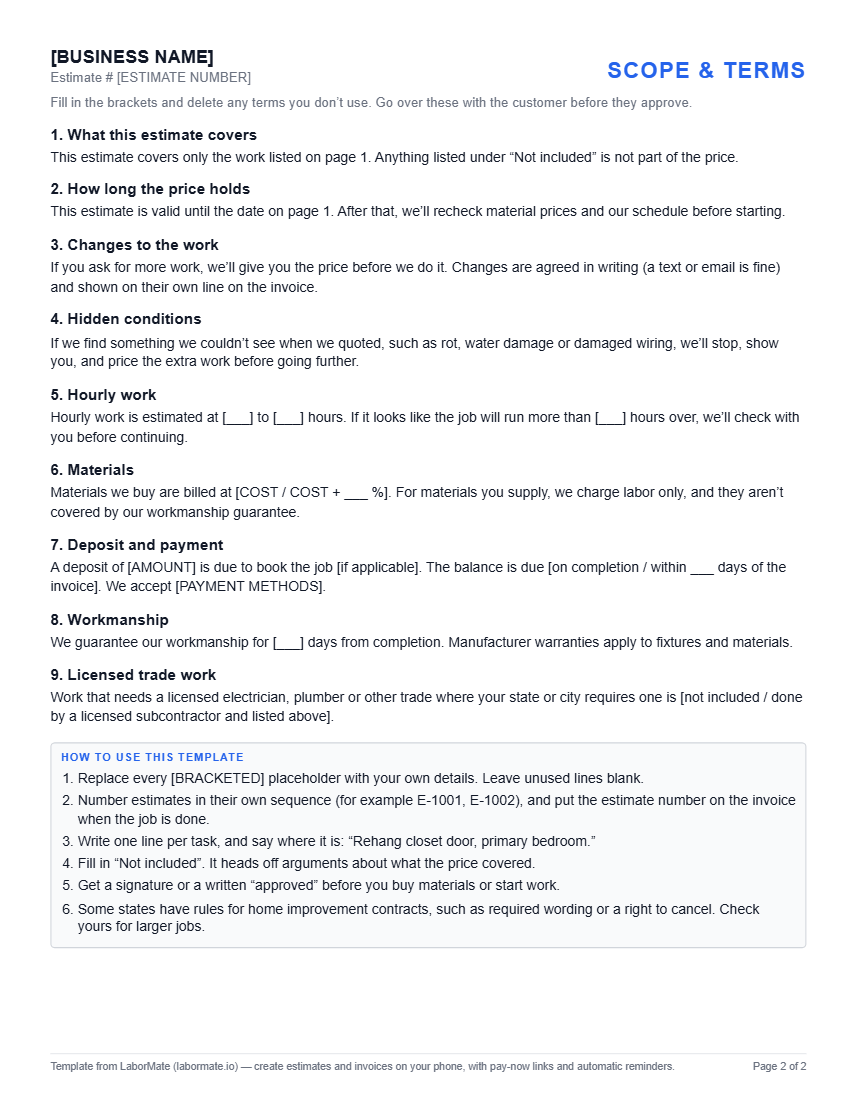
For hourly work, set a check-in point on page 2: if the job will run more than a set number of hours over, you call before you continue. It’s the simplest way to avoid a surprise bill.
How long the estimate stays valid
Material prices move and your calendar fills up, so an estimate shouldn’t stay open forever. Pick a period that suits your work, for example 14 or 30 days, and write the actual date in “Valid until” rather than “30 days”. A date can’t be misread.
If a customer comes back after it expires, you don’t have to turn them away. Recheck material prices, update anything that changed, and send a new estimate with a new date.
Handling scope changes and hidden damage
Trouble with an estimate tends to start partway through the job: the customer asks for “one more thing”, or you open up a wall and find rot.
- •The customer adds work: price it before you do it, get a yes in writing (a text is fine), and add it as its own line.
- •You find hidden damage: stop, take photos, show the customer, and price the fix before going further. Page 2 of the template already says you’ll do this, so it doesn’t come as a surprise.
- •The work needs a licensed trade: if a simple fixture swap turns out to need new wiring, that may be work your state reserves for a licensed electrician. Say so, and leave it out of your scope unless you hold the license.
Some states also have rules for home improvement contracts, such as required written terms or a right to cancel. If you take on larger jobs, check your state’s rules.
Turning an accepted estimate into an invoice
When the customer approves, keep the signed copy, or a screenshot of the “approved” text, with the job. Then:
- •1. If you’re taking a deposit, invoice it right away so it’s on record.
- •2. When the job is done, copy the estimate lines onto the invoice, using the actual hours for hourly work.
- •3. Add any approved changes as their own lines, marked “approved”.
- •4. Subtract the deposit, put the estimate number in the notes, and send the invoice the same day.
The free handyman invoice template has the same task, materials and fee lines, so the two documents match. To set the prices that go on both, see how to charge as a handyman. For bigger jobs with a lot of materials, see how to invoice for parts and labor.
Frequently asked questions
What should a handyman estimate include?
Your business details, the customer and job address, an estimate number and date, a valid-until date, each task with where it is, materials, any trip or disposal fee, and the estimated total. Add what’s not included, how changes will be handled, and a place for the customer to approve.
What’s the difference between an estimate and a quote?
An estimate is your best price for the work as you understand it, and it can change if the job turns out different. A quote is usually a fixed price for a defined job. People use the words loosely, so write on the estimate whether the price is fixed or hourly, and what happens if the work changes.
How long should a handyman estimate be valid?
Long enough for the customer to decide, and short enough that material prices and your schedule haven’t moved. Pick a period, for example 14 or 30 days, and write the actual expiry date on the estimate rather than a number of days.
Can a handyman charge more than the estimate?
Only for work that changed, and only after the customer agrees. If the customer adds work or you find hidden damage, stop, explain it, and get approval in writing before you continue. Some states also have consumer rules on how far a final bill can go over an estimate, so check yours.
Does the customer need to sign the estimate?
A signature is the clearest record that they approved the price and the scope. For small jobs, a reply of “approved” by text or email also gives you something in writing. For larger home improvement jobs, some states require a signed written contract, so check your state’s rules.
What format is the handyman estimate template?
A print-ready PDF and an editable Word (.docx) file, both US Letter and two pages: the estimate, then a page of scope and payment terms. Print the PDF to fill in by hand, or type into the Word file and save it as a PDF to send.