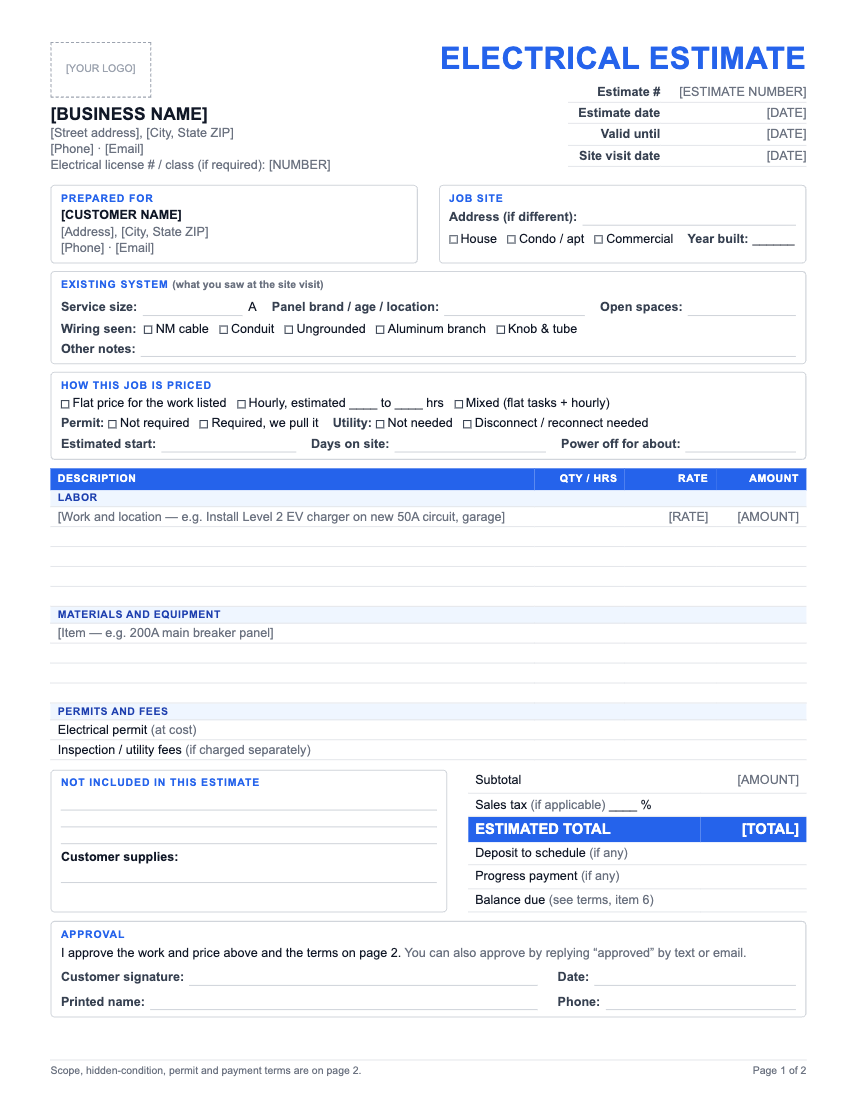
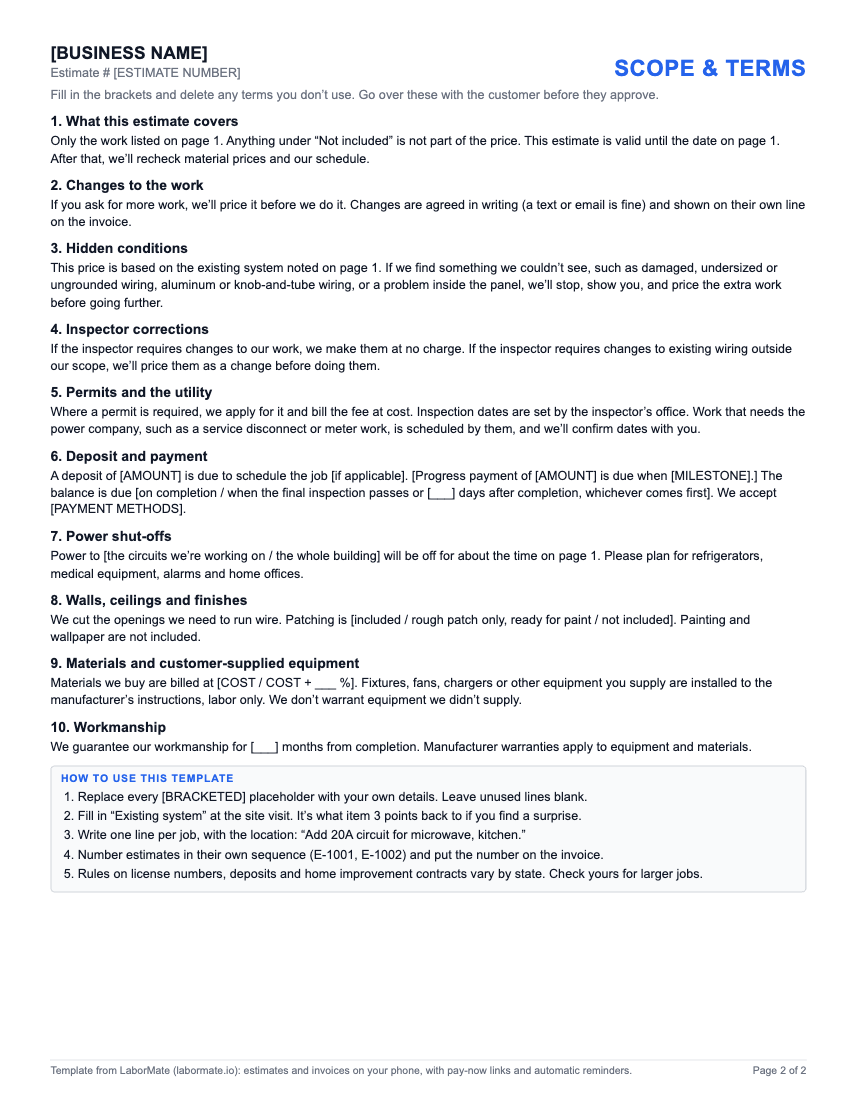
What’s on this electrical estimate template
- •Estimate number and dates. Estimate date, valid-until date and site visit date. A real valid-until date protects you when panel, breaker or wire prices change between the visit and the yes.
- •License number and class, if your state requires it on estimates or contracts. Check with your state licensing board.
- •Existing system. Service size, panel brand and age, open spaces, and the wiring you saw. Most estimate templates leave this out. Writing “100A panel, no open spaces, some ungrounded circuits” at the site visit is what lets you price a surprise fairly later.
- •How it’s priced, permit and utility. Flat, hourly or mixed. Whether you’re pulling a permit. Whether the power company has to disconnect or reconnect service, and roughly how long the power will be off.
- •Labor, materials and permits in separate sections, so the customer can see what moves if they pick a different fixture or charger.
- •Not included. For example: “Drywall patching beyond rough patch”, “Painting”, “Upgrading existing circuits not listed above”, “Utility company fees”.
- •Deposit, progress payment and balance, for jobs big enough to need them.
Before you price it: an electrical site-visit checklist
An electrical estimate is only as good as what you looked at. Go through this list at the site visit, and write what you find in the “Existing system” box.
| Check | Why it changes the estimate |
|---|---|
| Service size and panel | Brand, age and open spaces. A full or outdated panel can turn “add a circuit” into a subpanel or panel job. |
| Wiring type and condition | Ungrounded, aluminum or knob-and-tube wiring can mean extra work before you can tie into it. Note what you see either way. |
| Route from the panel | Distance sets the wire length. An open attic or basement is quick. Finished walls and ceilings are not. |
| Wall and ceiling finishes | Plaster, tile and high ceilings take longer to cut, fish and patch. |
| Protection the new work needs | New circuits may need AFCI or GFCI protection, which changes the breaker or device you price. It depends on the code your area has adopted. |
| Permit and inspection | The fee, your time to apply, and a return trip for the inspection. |
| Power company | Service upgrades and meter work run on the utility’s schedule, not yours. |
| Customer-supplied equipment | Get the model number. A charger’s breaker size or a heavy fixture’s box rating changes your materials. |
| Access | Crawlspaces, locked rooms, pets, parking. It’s time you’ll spend either way. |
Estimate, quote or bid?
Homeowners tend to ask for a “quote”. General contractors and commercial customers ask for a “bid”, which usually means a fixed price against their plans. An estimate is your best price for the work as you can see it, and it can change within the terms you set.
Whatever the customer calls it, the pricing box on page 1 is what counts. Tick “Flat price” for a defined install like a fixture, a new circuit or a panel swap. Tick “Hourly” with a range for open-ended work like tracing a fault, and agree to call before you go past the top of the range.
Hidden conditions and inspector corrections
Electrical work hides more than most trades. You open a box for a simple fixture swap and find a melted splice, or a panel cover comes off and the bus is scorched. Item 3 on page 2 covers this: you stop, show the customer, and price the fix before going further. Because you filled in “Existing system”, it’s clear the problem wasn’t something you could see when you priced it.
Item 4 covers the inspector. If they flag your work, you fix it at no charge. If they require changes to existing wiring outside your scope, that’s a change, priced and approved like any other. Agreeing on this up front saves an argument after a failed inspection.
Payment terms for panel upgrades and bigger jobs
For a service call, “due on completion” is enough. For a panel upgrade, a rewire or a remodel, set the payments to match the job:
- •Deposit to schedule, enough to cover equipment you have to order. Some states limit how much you can take up front on home improvement work, so check yours.
- •Progress payment at a milestone the customer can see, such as rough-in inspection passed.
- •Balance when the final inspection passes, or a set number of days after completion, whichever comes first, so a slow inspector doesn’t hold up your money.
For how to invoice each stage, see progress billing for contractors.
From signed estimate to invoice
- •1. Keep the signed estimate, or a screenshot of the “approved” text, with the job.
- •2. Invoice the deposit right away so it’s on record.
- •3. On the job, log time, materials and any approved changes.
- •4. When the work is done, copy the estimate lines onto the invoice, add approved changes as their own lines, subtract the deposit and put the estimate number in the notes.
For step 3, the free electrical work order and invoice PDF has a time log and a box for changes with the customer’s initials. For step 4, the electrician invoice template has the same labor, materials and permit lines. To set the rates that go into both, see how to price electrical work.
Frequently asked questions
What should an electrical estimate include?
Your business details and license number, the customer and job site, an estimate number, the date and a valid-until date. Then notes on the existing system, how the job is priced, labor, materials and permit lines, what’s not included, the estimated total with any deposit, your terms, and a place for the customer to approve.
How do electricians estimate a job?
Look at the job first: the panel, the wiring, the route the wire will take and the walls it goes through. List each task, estimate the hours and multiply by your rate, then add materials, permit fees and any markup. Write down what you saw, so a surprise behind the wall can be priced as a change.
How long should an electrical estimate be valid?
Long enough for the customer to decide, and short enough that wire and equipment prices haven’t moved much. Pick a period, for example 30 days, and write the actual expiry date on the estimate. If the customer comes back later, recheck your prices and send a new one.
Can an electrician charge more than the estimate?
Only for work that changed, and only after the customer agrees. In electrical work, common reasons are hidden wiring problems and corrections the inspector requires to existing wiring. Some states also limit how far a final bill can go over a written estimate without approval, so check yours.
Should the permit fee be on the estimate?
Yes. Put it on its own line, marked “at cost” if you pass it through, so the customer sees it before they approve. If you don’t know the exact fee yet, estimate it and say the final amount will match what the permit office charges.
What format is the electrical estimate template?
Both: a print-ready PDF to fill in by hand at the site visit, and an editable Word (.docx) file you can type into and save as a PDF to email. Each is two US Letter pages: the estimate, then electrical scope and payment terms.